

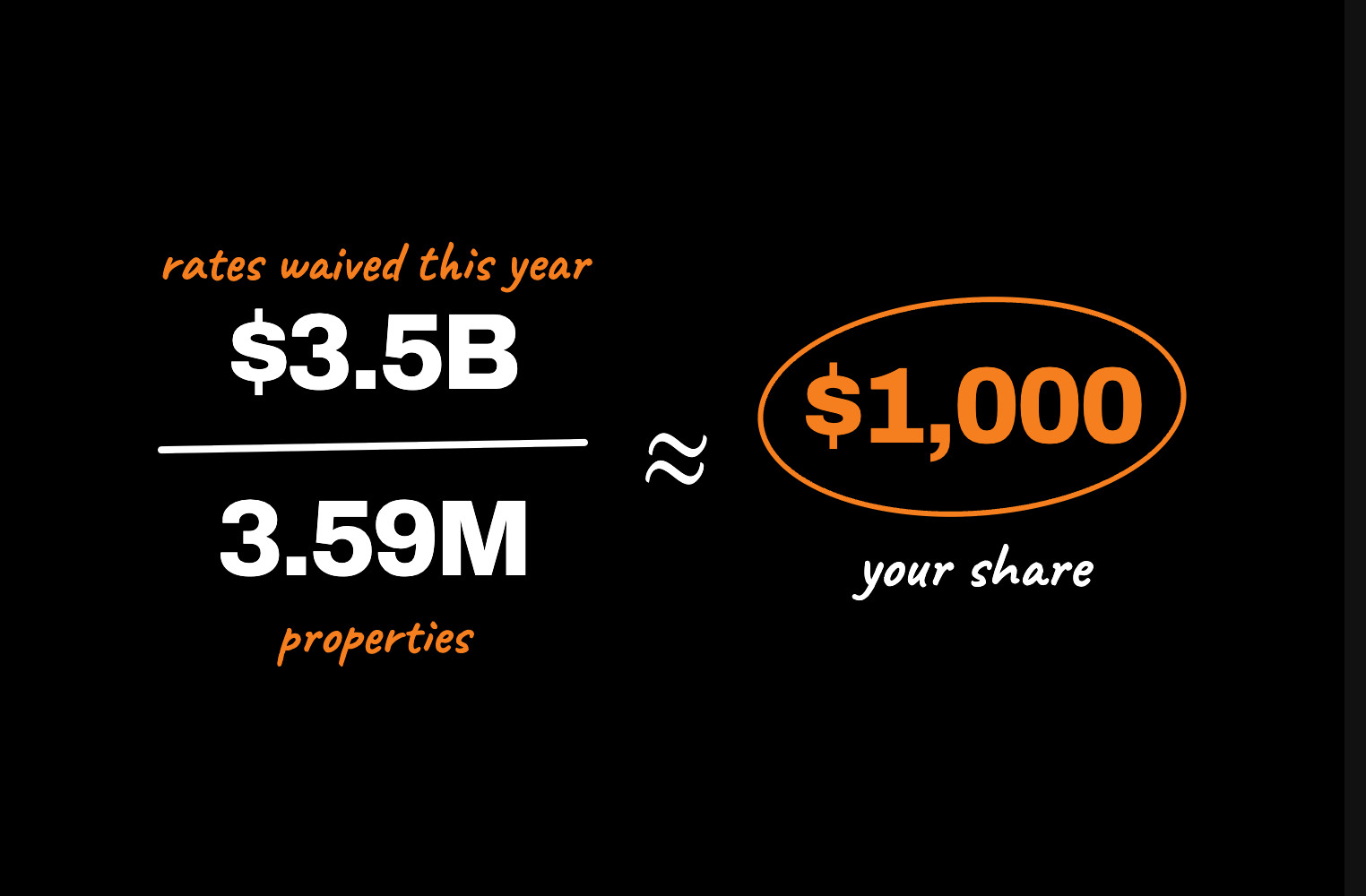
The government is giving up about $3.5 billion in rates this year, which sounds like a lot. It is less impressive once you divide it by the roughly 3.59 million rateable properties sharing it, and you get to about the cap: $1,000 a property, give or take.
That is the whole design. Rather than a big measure aimed at someone, it is a small measure aimed at everyone, and “everyone” is a very large denominator.The Measure
For the first two quarters of 2026/27:- Rates for both domestic and non-domestic properties will be reduced
- The concession is capped at $500 per quarter per rateable property
$1,000
This means the maximum total relief is $1,000 per property across the two quarters.
What Are “Rates”?
Rates are a recurring government charge based on the rateable value of a property, which is roughly what the government thinks it would rent for in a year. Rates are a percentage of that number.For most properties it’s a flat 5%. Homes with a rateable value above $550,000 pay a progressive scale:| Portion of rateable value | Rate |
|---|---|
| First $550,000 | 5% |
| Next $250,000 | 8% |
| Above $800,000 | 12% |
- owner-occupied
- rented out
- used for business
| Small flat | Mid-range flat | Luxury home | |
|---|---|---|---|
| Rateable value (per year) | $30,000 | $240,000 | $1,200,000 |
| Annual rates | $1,500 | $12,000 | $95,500 |
| Quarterly rates | $375 | $3,000 | $23,875 |
| Concession per quarter | $375 | $500 | $500 |
| Total relief for the year | $750 | $1,000 | $1,000 |
| Relief as % of annual rates | 50% | 8% | 1% |
(The luxury home’s rates: 5% × $550,000 = $27,500, plus 8% × $250,000 = $20,000, plus 12% × $400,000 = $48,000, for a total of $95,500.)
One catch
If your property is also charged Government rent, which is 3% of rateable value and often appears on the same demand note, the concession doesn’t touch that portion.Who Benefits
The impact is spread across different groups:Homeowners
Lower ongoing property costs.Landlords
Slight improvement in net returns.Businesses
Reduced operating costs for commercial spaces such as offices and restaurants.Why the Cap Matters
The $500 cap per quarter is intentional.It ensures the measure:- Reaches a wide base of properties
- Avoids concentrating benefits on high-value assets
- Keeps the fiscal exposure manageable
How This Fits Into the Budget
This sits alongside other relief measures including:- The one-off salaries tax reduction for 2025/26
- Higher personal and family allowances from 2026/27


